When AI Tools Start Feeding Each Other: Our New Dev Workflow Experiment
Lately, we've been running a workflow experiment that feels like a real turning point in how we build.
The setup is simple but powerful:
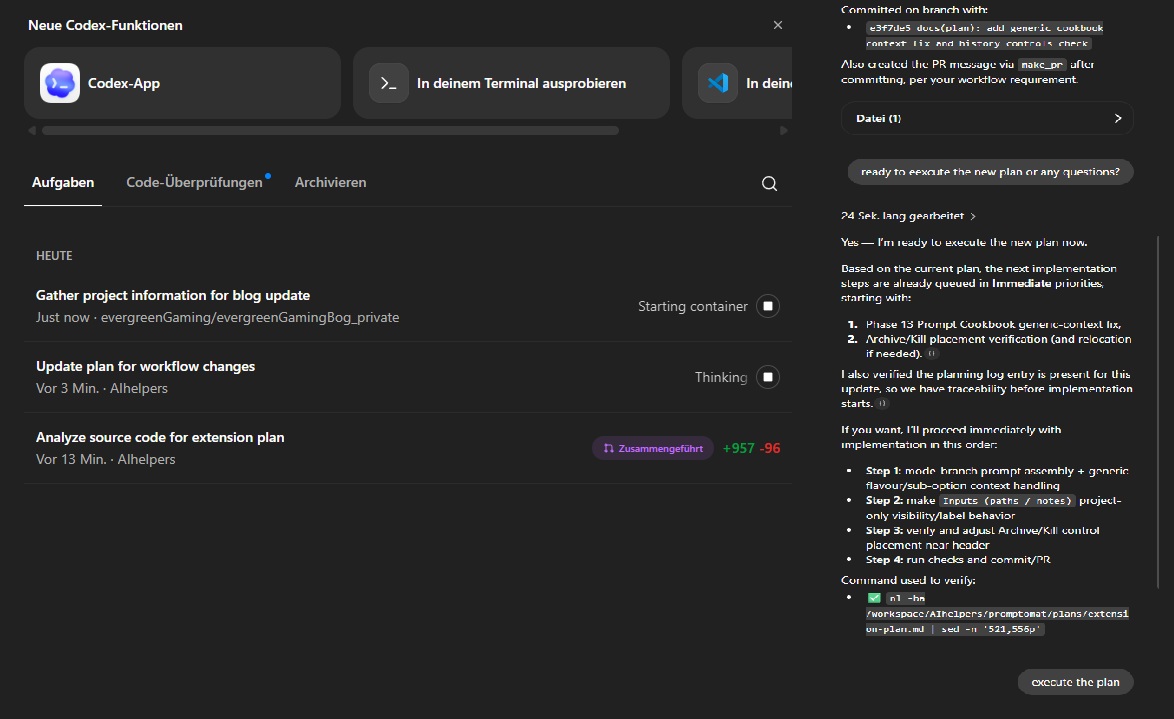
- Codex/CYOU as a sandboxed execution environment, linked to GitHub
- Copilot + VS Code for local split-screen iteration, review, and validation
- PR-first collaboration as the shared checkpoint between both sides
 Click image to enlarge ↗
The Workflow We Tested
We used Codex/CYOU to handle scoped implementation work in a sandbox, with changes tracked cleanly through GitHub. At the same time, in local VS Code (with Copilot), we reviewed, refined, and validated changes side-by-side — often in split screen while PRs were still evolving.
That gave us a fast loop:
- Prototype in sandbox
- Open/inspect PRs in GitHub
- Validate and refine locally in VS Code
- Feed findings back into the next iteration
It felt less like “tool switching” and more like one connected system.
Parallel Project Experiment
One of the most interesting parts: we even tried this across multiple projects at the same time. In this exact moment, we're updating this blog while also iterating on small internal tools using the same process.
Instead of context-switch chaos, we got a surprisingly smooth rhythm:
- clear boundaries in sandbox branches,
- local confidence checks in editor,
- fast feedback through PRs.
What Changed for Us
This experiment made something obvious:
We're no longer just using AI tools.
We're building a cycle where each tool improves the others.
The blog documents the experiments. The tools improve from what we learn. Those improved tools make the next experiment better. And each iteration compounds.
That recursive loop — experiment → tool improvement → better experiment — is exactly what makes this exciting.
Why This Matters
This isn't just about speed. It's about creating a living development system that grows with us:
- workflows become reusable,
- experiments become structured,
- insights become operational improvements.
The most exciting part is that the tooling itself evolves alongside the process.
We're not just shipping features anymore. We're evolving the way we build.